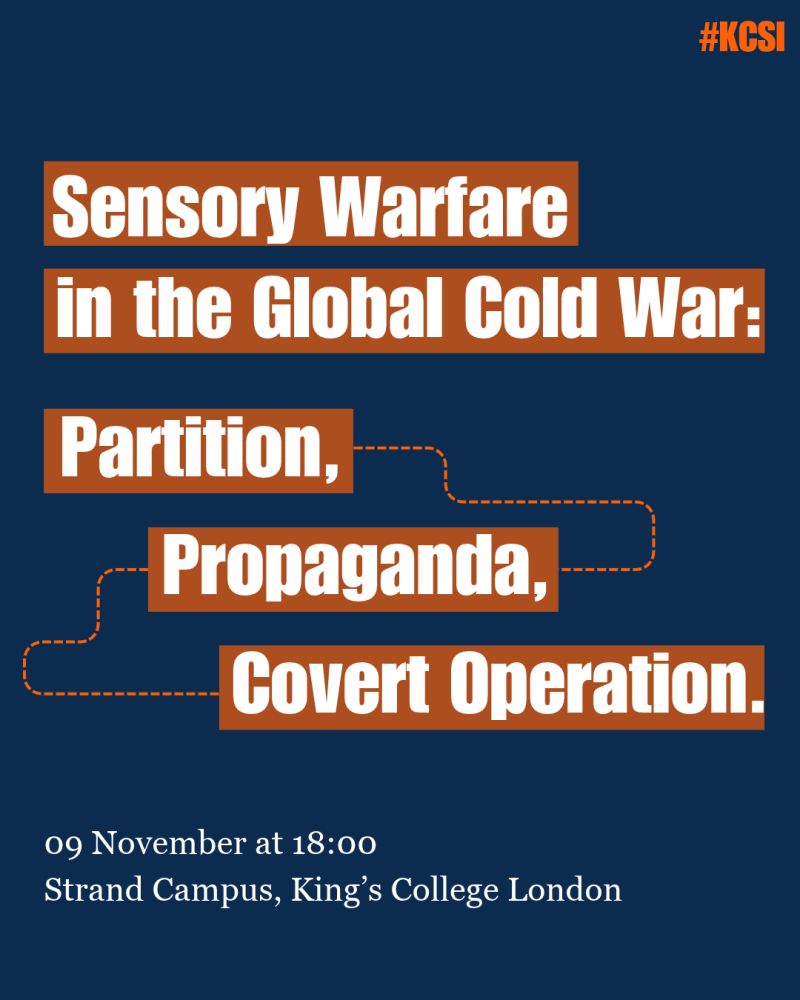
Join the King’s Centre for the Study of Intelligence (KCSI) for an exciting panel celebrating the edited collection: Sensory Warfare in the Global Cold War: Partition, Propaganda, Covert Operation (Penn State UP, 2026).
Reserve your spot here: https://www.eventbrite.co.uk/e/book-launch-sensory-warfare-in-the-global-cold-war-tickets-2003347419059
The longest political conflict of the twentieth century, the Cold War, was carried out on the human senses—and through them. Largely conducted through nonlethal methods, it was a war of competing cultures, politics, and covert operations. While propaganda reached targets through vision and hearing, sensory warfare also exploited taste, touch, smell, and pain. Sensory Warfare in the Global Cold War is the first book to explore the sensory aspect of the Cold War and how this warfare changed contemporary perception of the war.
The authors of this volume highlight the global dimension of sensory warfare, examining battlegrounds around the world and across different phases of the conflict, including “cold” and “hot” warfare—both covert and overt. Case studies highlight the role of taste in Western food deliveries to Eastern Europe; olfaction in Poland, at the Iron Curtain, and in the Vietnam War; sonic warfare in Berlin, in Romania, and at the China-Taiwan “aquatic frontier”; vision in the Maoist Cultural Revolution, Spain, and the Soviet-Afghan war; haptics in the German military; and drugs, pain, and sensory deprivation in intelligence operations in both Hungary and the United States. In its wide-ranging treatment, this volume offers an illuminating new perspective on the Cold War and deepens our understanding of the sensory aspects of current and future conflicts.
The contributors to this volume include Cyril Cordoba, Mark Fenemore, Walter E. Grunden, Dayton Lekner, José Manuel López Torán, Markus Mirschel, Victoria Phillips, Carsten Richter, Andreea Deciu Ritivoi, Christy Spackman, Stephanie Weismann, and the volume’s editor, Bodo Mrozek.
Speakers
Chair: Michael Goodman, Professor of ‘Intelligence and International Affairs’ and the Director of the King’s Centre for the Study of Intelligence.
Mark Fenemore, Manchester, the author of Fighting the Cold War in Post-Blockade, Pre-Wall Berlin: Behind Enemy Lines (2020).
José Manuel López Torán, University of Castilla-La Mancha, Toledo, lecturer, and the author of La batalla por las emociones.
Bodo Mrozek Berlin Center for Cold War Studies, senior researcher and the editor of Sensory Warfare in the Global Cold War: Partition, Propaganda, Covert Operations.
Victoria Philipps, Oxford, director of the Cold War Archival Research project (CWAR) and the author of Martha Graham’s Cold War: The Dance of American Diplomacy.