The one-day conference Crossing Borders: Transnational Perspectives on Life-Writing and Ego-Documents, held at the University of Southampton on 14 April 2026, brought together scholars from literary studies, history, linguistics, modern languages, Holocaust studies, and cultural memory studies from UK and international institutions.
The 17 contributions explored how life-writing operates across national, linguistic, political, and imperial boundaries and highlighted the analytical value of ego-documents (diaries, correspondence, memoirs, petitions, and autobiographical texts) as sources for examining mobility, identity formation, displacement, and transnational knowledge transfer. The conference was structured around seven thematic panels, showing the diversity of approaches and historical contexts in which transnational life-writing is produced.
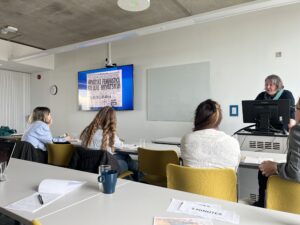
Panels in the morning sessions addressed mobility and mediation, beginning with Navigating and Narrating Transnationally, which explored migration narratives from nineteenth-century Polish exiles in Britain, in Hebrew-Christian autobiographies, to Jewish refugee correspondence between Europe and East Asia during the Holocaust. These papers emphasised how personal writings both recorded and actively shaped transnational experiences, challenging narratives of passive migration. Running in parallel, Language and Mediation in Transnational Writing focused on multilingualism, second-language life-writing, and exile. Papers examined the use of L2 Italian in contemporary autobiographical writing, metalinguistic reflection in Holocaust-era ego-documents, and Dubravka Ugrešić’s autobiographical texts as records of exile beyond national linguistic belonging. Together, these contributions foregrounded language as both a constraint and a creative resource in transnational self-narration.
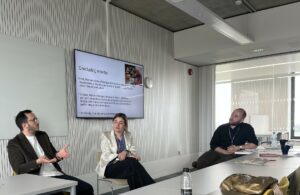
The late-morning panels turned towards questions of memory, generation, and postwar identity. Generational Life Writing and Archival Memory examined how ego-documents function across time, families, and archives, with papers addressing collaborative memoirs, diasporic writing, and the transmission of memory beyond the first generation. These contributions highlighted how personal narratives are shaped through processes of mediation, translation, and curation, and how life-writing – at the same time – can act as testimony, memorial practice, and historical intervention. In parallel, Identity Formation and Life Writing in the Postwar Era focused on autobiographical and epistolary texts produced in the aftermath of the Second World War. Papers explored the long-term consequences of Nazi racial policies, exile, and intellectual displacement, emphasising ego-documents as sites of relational selfhood embedded within social, political, and institutional networks.
The first afternoon session addressed crisis, survival, and narrative constraint. Rescue and Relief in the Holocaust foregrounded correspondence, petitions, and administrative ego-documents produced under conditions of persecution and uncertainty. Speakers examined how individuals navigated censorship and bureaucracy through writing. The panel stressed the importance of attending to affective and ethical dimensions of ego-documents, expanding conventional understandings of relief beyond material support to include friendship, solidarity, and moral responsibility. Running alongside this, Gendered Dimensions in Transnational Narratives explored how gender shapes experiences of cross-border movement and self-representation. Papers ranged from eighteenth- and nineteenth-century travel accounts to contemporary life-writing concerned with reproductive mobility and postwar exile. The panel emphasised the value of gender as a critical lens for reading transnational ego-documents and for recovering perspectives marginalised within official or state-centred archives.
The final panel, Life Writing in the Shadow of Empire, situated ego-documents within imperial, colonial, and trans-imperial contexts. Papers examined fragmented and polyphonic forms of life-writing shaped by colonial power, linguistic conflict, and cultural mediation, challenging nation-centred frameworks for understanding autobiographical texts. Collectively, the panel demonstrated how ego-documents can unsettle linear narratives of empire by foregrounding ambivalence, hybridity, and negotiated forms of selfhood.
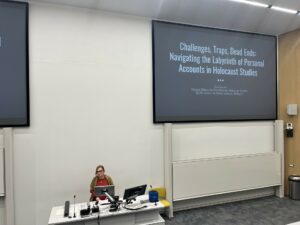
The conference concluded with a public keynote lecture by Prof. Éva Kovács (Vienna Wiesenthal Institute) on “Challenges, Traps and Dead Ends: Navigating the Labyrinth of Personal Accounts in Holocaust Studies.” Kovács reflected on the methodological and ethical complexities of working with personal testimony, addressing issues of representativeness, silence, contradiction, and interpretive responsibility. Her lecture resonated strongly with the themes of the day, underscoring the importance of critically engaged and historically situated readings of ego-documents.
Overall, Crossing Borders demonstrated the relevance of life-writing as a key site for transnational analysis. By bringing together scholars working across periods, regions, and disciplines, the conference fostered productive dialogue on how personal narratives cross borders and how scholars might responsibly follow them.
The event was organised by Dr Monja Stahlberger (University of Reading & University of London), Dr Charlie Knight (University of London), and Dr Rachel Pistol (University of Southampton), with generous support from the German History Society, the Modern Humanities Research Association, and the Leo Baeck Institute London.